
 Skip to content


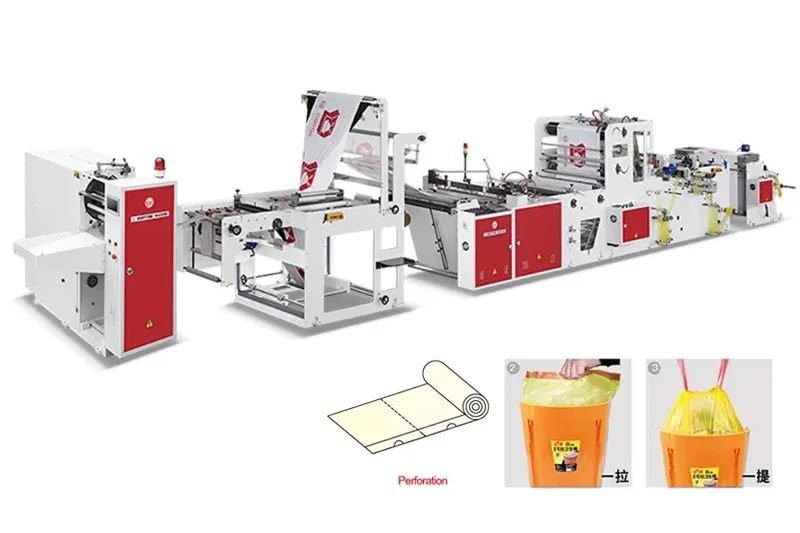
A trash bag line is judged by two things the customer never sees: whether the perforation tears cleanly on the last bag of the roll, and whether the roll is wound tight enough to survive a shipping carton. Both are decided by routine, not by the machine’s specification. A well-run 60 m/min line out-produces a neglected 80 m/min one every month.
This is the operating routine we recommend for a roll-type trash bag machine: what to check before the shift, how to start, what to watch while running, and how to shut down so tomorrow’s start is short.
Before the checklist, be clear about the three jobs the machine performs simultaneously:
● Sealing — a bottom seal closes one end of the tube. Seal quality depends on temperature, pressure and dwell, in that order of sensitivity.
● Perforating or cutting — a perforation line lets the user tear one bag from the roll; a full cut separates bags for packing. A perforation that is too deep tears in transit, too shallow and the customer cannot separate the bags.
● Winding — the finished web is wound onto a core or coreless roll at controlled tension. Winding is where most visible defects originate: telescoping, slack rolls, bag offsets.
On the rolling garbage bag machine family these three run in line, which is why a fault in one area usually shows up as a symptom in another.
Ten minutes here prevents most of the shift’s scrap:
● Film roll — correct structure and thickness, width matching the recipe, no damaged edges, and enough left for the planned run.
● Teflon and sealing bar — no holes, no burnt residue, bar surface clean and parallel. A single pinhole in the Teflon produces a repeating weak spot in every bag.
● Temperature — confirm the displayed value matches the recipe, and give the bar time to equalise. Starting cold and chasing temperature is the most common cause of first-hour scrap.
● Perforation blade — clean, correctly seated, and matched to film thickness. A dull blade produces ragged tears that only appear after the roll is wound.
● Cores and shafts — correct core diameter, chuck pressure, and no tape residue on the shaft that can make the roll slip.
● Air pressure — at least 6 bar at the machine inlet, with the filter bowl drained.
● Photocell and guides — lens clean, web path free of dust and trim, edge guides set to the film width.
● Safety — guards in place, emergency stop tested, and no tools left on the sealing deck.
Order matters, because each step depends on the previous one being stable:
● Power and air — switch on, confirm no alarms, let the HMI finish booting before touching parameters.
● Heat to setpoint — typically 5 to 10 minutes depending on bar mass. Do not thread film while the bar is still climbing.
● Thread the web — through the dancer, around the guide rollers, under the sealing bar, past the perforation station, to the winder. Keep tension even while threading; a slack thread produces a wrinkle that persists for metres.
● Set the recipe — bag length, width, count per roll, perforation mode, winder tension. Load the stored recipe rather than editing numbers on the fly.
● Run at low speed — 30 to 40 percent for the first few metres. Check seal strength by pulling a bag apart, check perforation by tearing one, check roll alignment.
● Ramp to production speed — increase in steps and watch bag length over 20 pieces. If length drifts as speed rises, stop and check the feed nip before continuing.
These four observations catch almost everything before it becomes scrap:
● Seal — peel one bag. A seal that opens with a clean peel is under-cooked; one that tears the film is at temperature. Aim for film tear, not seal peel.
● Perforation — tear a bag off the roll. It should separate with a firm pull and leave a clean line. Ragged or pre-torn means the blade needs attention.
● Roll build — check for telescoping, soft edges and bag offsets. A roll that looks wrong at 30 percent build will be scrap at 100 percent.
● Sound and vibration — new noises are cheaper to fix in the first ten minutes than after a shift. A rhythmic knock usually means a bearing or a loose pulley.
Bag length is worth checking with a ruler, not by eye. On a perforated roll, a 3 mm drift per bag becomes 90 mm over thirty bags, and the customer notices before you do.
Two subsystems deserve more attention than they usually get:
● Perforation depth — set by blade pressure and anvil condition. Too deep and the bag tears in the carton; too shallow and the user needs scissors. Adjust in small increments and test after each change, never in bulk.
● Winding tension — should decrease slightly as the roll diameter grows, otherwise the outer layers crush the inner ones. Machines with taper tension control handle this automatically; on simpler machines the operator must step tension down manually at 50 and 75 percent build.
● Core alignment — a core that is not square to the shaft produces a roll with one soft edge. Check the chuck and the core itself; damaged cores are common with recycled cardboard.
● Web tension at the unwind — a roll that is wound unevenly from the film supplier will pulse through the whole line. If tension oscillates once per revolution, the problem arrived with the film.
The CW-1000PR+C2 bag-on-roll machine illustrates how much of this can be automated: four servo axes, a swing sealing principle that keeps the film moving during sealing, and both cored and coreless winding on the same frame.
Changeover is where machines differ most in practice, and where discipline pays:
● Record the running recipe first — parameters for the outgoing size, so you can return to it without re-tuning from scratch. Factories that skip this step lose an hour every time they switch back.
● Change one variable at a time — length, then width, then count. Changing three parameters together makes diagnosis impossible if the first roll fails.
● Recalibrate perforation and sealing — both depend on film thickness and speed, and both will be wrong after a size change until proven right.
● Run a 20-bag sample and keep it — a signed sample from each size change becomes the reference for the next shift and for customer disputes.

Twenty minutes of closing routine buys back an hour at the next start:
● Finish the roll — never leave a partially wound roll on the shaft overnight; it relaxes and produces a soft start on the next shift.
● Cool and clean the sealing bar — let it cool, then remove residue with a soft tool. Scraping a hot bar damages the surface.
● Clean photocells and blades — dust and film trim are the two most common causes of a bad first hour.
● Record output, scrap and stops — three numbers per shift. Without them, improvement is guesswork.
● Isolate and lock off if maintenance is planned — and leave a note on the HMI so the next operator knows the machine is not ready.
Seven symptoms cover most of what an operator will meet:
● Seal peels open — temperature low, dwell short, pressure low, or Teflon worn. Check in that order.
● Seal tears the film — temperature high, dwell long, or the bar is not parallel. Parallelism shows as one side of the bag failing first.
● Bag length drifts — feed nip pressure, worn pull-out belt, or film tension changing as the roll diameter falls. Measure over 20 bags to see whether the drift is progressive or sudden.
● Perforation tears in the carton — blade too deep, or winding tension too high crushing the perforation line.
● Roll telescopes — tension too low at the start, or the web is not square to the core. Check edge guide before touching tension.
● Wrinkles along one edge — film roll damage, guide roller misalignment, or a cold seal bar dragging on the web.
● Machine stops with a drive alarm — usually voltage sag, overload from a jam, or an encoder fault. Note the alarm code; the same code recurring is a pattern, not bad luck.
Trash bag machines have heat, moving knives and rotating shafts within arm’s reach:
● Never reach into the sealing or perforation area while the machine is powered, even at low speed, even with the guard open for a second.
● Use the lockout procedure for blade changes — a perforation blade is sharp on both faces and does not announce itself.
● Keep loose clothing and gloves away from the winder — a shaft will take a glove and the hand inside it.
● Do not bypass interlocks to save a stop — the interlock exists because the sequence it prevents has injured someone.
Want this routine as a shift checklist for your floor?
Tell us the model and bag sizes you run. We will send a printable start-up, running and shutdown checklist matched to your machine configuration, plus the alarm list with likely causes.
Every thirty minutes for seal, perforation, roll build and unusual noise. A full parameter review at the start of each shift, and a bag length measurement over twenty pieces at least twice a shift.
Either the perforation is too deep or the winding tension is too high, which crushes the perforation line as the roll builds. Reduce blade pressure first, then step down tension at 50 and 75 percent roll diameter.
It depends on film structure and thickness, not on a universal number. Start at the value in the machine recipe for that film, then adjust in 5 °C steps until a peel test tears the film rather than opening the seal.
Twenty to thirty minutes from cold: five to ten minutes of heat-up, five minutes of threading, and ten minutes of low-speed checks. Starting before the bar has equalised is the most common cause of first-hour scrap.
Some can. The CW-1000PR+C2, for example, is built for both, with different winding shafts and tension profiles. Converting between them is a changeover task, not a rebuild, but confirm the tooling is included before ordering.
Winding tension too low at the start of the roll, or a web that is not square to the core. Check the edge guide and the chuck alignment before increasing tension, because adding tension to a misaligned web produces a tight but still conical roll.
Four measures, in order of impact: stabilise sealing temperature before production, keep perforation blades sharp, record scrap per shift so causes are visible, and stop changing parameters mid-roll. Most lines can halve scrap within a month by doing only these.
● How Garbage Bag Making Machines Work — the process behind the routine.
● Types of Garbage Bag Making Machines — which configuration matches which product.
● How to Choose a Cost-Effective Garbage Bag Making Machine — before the routine matters.
Coming next: Perforation Blade Selection for Trash Bag Rolls, and Winding Tension Profiles: Core versus Coreless.

